Schrodinger's Israel
On Teiku and Migos

They’re fighting about Israel again.
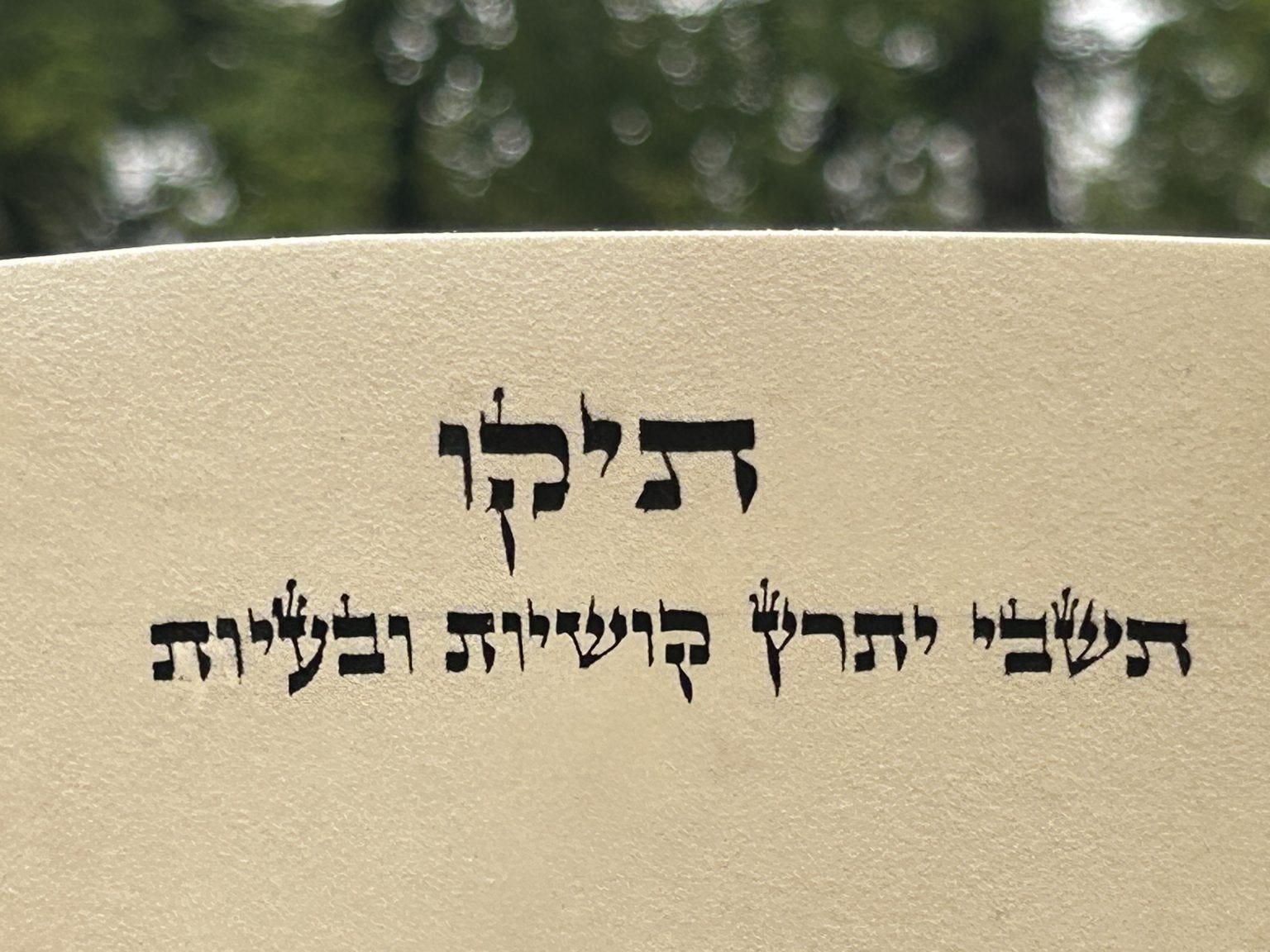
The proximate cause this time was a student letter, signed by a small number of JTS students and alumni, calling for the seminary to rescind its commencement invitation to Israeli President Isaac Herzog. The Forward covered it, JTS’ Chancellor responded fairly evenhandedly here and if you want the background you can read all the pieces linked above. She was going to invite him, she did invite him, and that, institutionally speaking, is that.
But I want to talk about the fighting Rabbis. In my (recently deactivated) Facebook Conservative Rabbis group, you might not be shocked to hear that this imbroglio caused a lot of digital ink to be spilled. As is often the case in that group, there was some generational divide rupturing out in real time and the conversation, at least between some, was rancorous and frankly, unbecoming of clergy.
It read so toxically to me that it was finally the straw that broke the camel’s back for me for my aforementioned deactivation. There are only so many cute kid photos and life updates that can counterbalance the vitriol. If we can’t expect clergy to play nicely, even when the stakes are high, then what should we expect of the rest of the populace?
I get it. Israel is a hot button topic, especially since October 7th. I say this as someone with a deep and unwavering commitment to Zionism, despite my willingness to criticize Israel’s government. I’ve spent various years in Israel learning, praying, working, and genuinely being in relationship with it. But there has to be a pathway forward for being able to talk about it.
I don’t fully agree with the sentiments shared by these students. The notion of rescinding an invitation because a speaker would make students uncomfortable feels a bit myopic to me and the tone felt a bit heavy handed…and yet, as an educator who has worked with young people for nearly two decades now, what do we think happens when we tell kids that their Jewish history, identity, and legacy should give them a voice with which to speak?
If that voice happens to express ideas and opinions that not only bother us but make us worried about Jewish continuity, then let’s create spaces where that conversation can take place. And for the Rabbis in this group that supported the students’ letter, is the mentschy response really to mudsling and excoriate their fellow clergy?
This all brings me to Schrödinger’s cat, one of the very few things I learned and understood in high school science.
For the uninitiated: in 1935, the physicist Erwin Schrödinger proposed a thought experiment. A cat is placed in a sealed box with a tiny radioactive atom. If the atom decays, it triggers a mechanism that kills the cat. If it doesn’t, the cat lives. The twist is that according to quantum mechanics, until the box is opened and an observation is made, the atom exists in such a way that it has both decayed and not decayed simultaneously. Which means the cat is, in some genuinely non-metaphorical sense, both alive and dead at the same time.
I don’t mean to be reductive when I say this but Israel is the cat. Not in the sense that cats run rampant around Israel, which is very true. But for the purposes of this thought experiment, Israel is Schrödinger’s cat.
Not in the lazy “it’s complicated” sense that we reach for when we want to sound thoughtful while saying nothing. I mean it in a more structurally precise way. For one community of Jews, and I count myself somewhere in this camp, Israel is perpetually, achingly alive. The aliveness is the whole point. To demonize it, to withdraw support, to platform its critics at a seminary commencement, feels like opening the box and declaring the cat dead before it has had a chance to live out its natural life.
For another community, including, I suspect, those who signed that letter, Israel as a moral project is not dead but dangerously deadened, and the only way to revivify it is through the kind of sharp, unsparing criticism that forces a reckoning. For them, the protective instinct of the first camp is suffocating. In their mind, there’s no room for debate. The ironic thing is the other camp feels the same.
This is where Schrödinger gets interesting. The thought experiment wasn’t designed to celebrate superposition, that state where the cat is both alive and dead. Schrödinger meant it as a reductio ad absurdum, a way of showing that something has gone wrong with the framework when you try to apply quantum logic to a living cat. The problem is that we’re using the wrong tools to ask the question.
Those rabbis in that Facebook group, hurling digital ink at each other over this letter, weren’t observing the same cat. The “alive, protect it” community is primarily observing Israel as a political and historical fact; it represents an act of Jewish self-determination in a world that has not always wished Jews well. The “revivify through critique” community is primarily observing Israel as a moral and ethical project; it has transformed into a set of founding ideals that must be held accountable, or else the project has already failed on its own terms. Those camps are running different experiments, running on different equipment, and asking different questions.
That is why no one is going to win this argument. And which is why the vitriol is so particularly sad to witness among clergy who should know better. You cannot win an argument in which you and your interlocutor are not, in fact, arguing about the same thing.
The Talmud has a concept for this. Teiku, the term used when a legal dispute cannot be resolved by the available interpretive tools, and the question is left open until Elijah arrives with better ones. Teiku, often misunderstood, isn’t a shrug, and it isn’t an admission that both sides are equally wrong, or equally right, or that the truth lies somewhere in the middle. It’s a precise epistemological claim that both arguments are coherent, that neither can be dismissed, and that the current moment does not yet possess the framework to adjudicate between them.
The Chiddushe Harim, the first Gerrer Rebbe, makes a move on a strange case in the Talmud’s tractate of Bava Metzia 37a that popped into head this week. Two people deposit money with a third party: one deposits $100, one deposits $200. Each one claims the $200 is his. Normally in Jewish law, a claimant has what’s called a migo: if you could have made a stronger claim but chose a weaker one, we believe you, on the logic that a liar would have just made the stronger claim. The migo is, at its core, a credibility argument. It says that the very restraint of your claim is evidence of its honesty.
Now look at those two camps. I’m going to generalize a bit for the sake of this piece but i’ll note that there were some having a heated, albeit civil debate. This piece is about those on the extreme. The pro-student rabbis, the ones who got pilloried in that Facebook thread, have a migo, not necessarily for the substance of what the students said, but for how they chose to engage with it." They could have abandoned the institution entirely, declared Conservative Judaism complicit, and walked away from the whole project. Instead they stayed in the room and argued from within about what the seminary should represent. Do I disagree with the sentiment? Sure, but that continued presence is the migo. You don't fight this hard for something you've given up on.
The other camp has no migo. They went straight for the strongest and most dismissive claim available. These students are anti-Israel and not to be taken seriously. There is real restraint lacking in that claim. That’s the maximalist position, swung like a cudgel. And here is the Talmudic problem with that move. A claimant who reaches immediately for the most aggressive claim available has, by definition, forfeited the credibility that migo is designed to establish.
The Chiddushe Harim’s framework doesn’t produce a teiku here, because a teiku requires two coherent, good-faith claims of equivalent structure standing in genuine tension. What happened in that Facebook group wasn’t a teiku. It was one side showing up with a migo and the other showing up with a bludgeon and calling it the same thing.
Which means the $200 never had a chance of sitting in honest suspension. One party grabbed for it the moment the box opened.
Those pro-student rabbis on Facebook had a coherent migo and knew it. The response coming back at them was a dismissal dressed up as an argument. The Chiddushe Harim would have recognized the difference immediately. A teiku requires two claimants who have both done the hard work of restraint and both made the vulnerable claim rather than the easy one. What happened in that group was more of a one side arriving with genuine argumentative integrity and the other side arriving with certainty pre-loaded and a finger already pointing.
You can’t Elijah your way out of that because the money doesn’t sit in honest suspension when one party already has their hand in the box.
Clergy have to be better at this, which importantly doesn’t mean diluting your convictions. I mean better in the sense that the tradition handed us the exact vocabulary for moments like this one, and the rabbis who went straight for contempt put that vocabulary down.
The students did what their Jewish education trained them to do. They found a voice and used it. That voice said something that made a lot of people uncomfortable, including me. But discomfort is not the same as danger, and a letter is not a desecration, and fellow clergy deserves better than a Facebook pile-on no matter how wrong you think they are.
Schrödinger understood that the problem is usually the framework, not the cat. The Chiddushe Harim understood that a migo without restraint isn’t a migo at all. Clergy understand how to be mentsches. We sometimes need a reminder for how to actually act that way.
Shabbat Shalom and Happy Weekend
Thanks Rabbi. I'm troubled by the concept that in essence the more polite, open minded litigant should come out ahead. Would seem to me that the one with the better facts should. Nevertheless, food for thought. Shabbat Shalom
brilliant. thank you! Shabbat Shalom!