Murmurations
To and Fro

Whenever we have the opportunity to look at our wedding pictures, Lauren lovingly mocks me for looking so serious in all of them. Admittedly, my stoic face does give somber vibes. Every time, I lovingly argue back that I wasn’t serious in the form of sadness but serious in the form of the weightiness of what it means to promise oneself in partnership. That moments stands out for how immense it felt on an existential level. Know the feeling?
Just this week, I found some proof for it in nature! Approach-avoidance conflict is a social psychological construct that when faced with experiences in life that have both positive and negative outcomes, people tend to oscillate intensely between them. The understanding had been that whichever of the two feelings was felt more strongly, it would win out. Thankfully, saying yes was the stronger feeling for me!
Interestingly though, scientists have taken that understanding and recalibrated it. The capacity to sustain the tension, to remain in oscillation rather than collapsing solely to one option, is itself adaptive. The resolution of the tension too quickly, in either direction, tends to produce worse outcomes than tolerating it. In other words, being able to go to and fro between the two options is the healthiest choice.
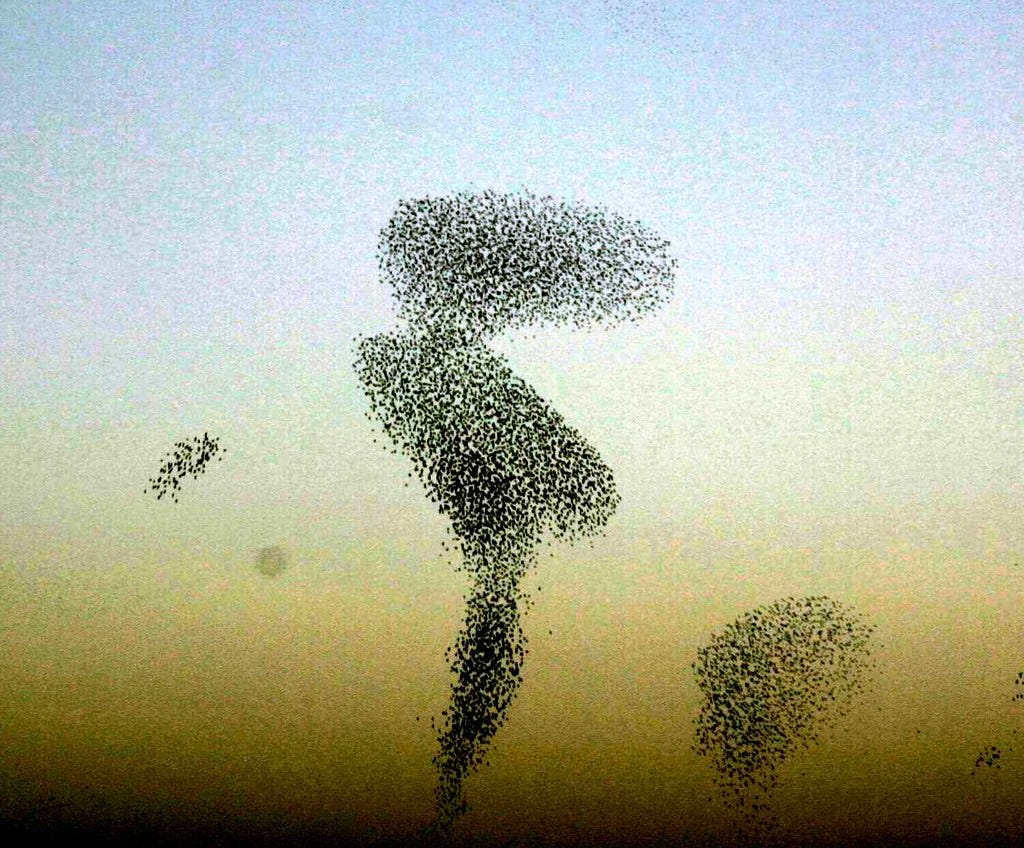
One example of this is a murmuration, the massive coordinated aerial displays of thousands of starlings, which is fundamentally an oscillation mechanism. Individual birds move toward the center of the flock when they sense threat, then push back out when the density gets too high. The flock as a whole pulses and expands rhythmically. What's remarkable is that no individual bird is directing this. The behavior emerges from each bird following simple rules about its nearest neighbors. The oscillation becomes the safety mechanism.
I dug into this as I was preparing for Shavuot next week and I came across a magnificent Midrash that totally reshapes the well established narrative of revelation. In Exodus 20:15, as the people are receiving the Torah, we read:
וְכׇל־הָעָם֩ רֹאִ֨ים אֶת־הַקּוֹלֹ֜ת וְאֶת־הַלַּפִּידִ֗ם וְאֵת֙ ק֣וֹל הַשֹּׁפָ֔ר וְאֶת־הָהָ֖ר עָשֵׁ֑ן וַיַּ֤רְא הָעָם֙ וַיָּנֻ֔עוּ וַיַּֽעַמְד֖וּ מֵֽרָחֹֽק׃
All the people witnessed the thunder and lightning, the blare of the horn and the mountain smoking; and when the people saw it, they fell back and stood at a distance.
That last clause expressed a serious moment of trepidation. The people are frightened so they move away from the intensity of this moment but the Mekhilta d’Rabbi Yishmael (9:9) reframes it:
‘And they stood from afar': outside of twelve miles (the distance of the Israelite encampment). We are hereby apprised that Israel receded twelve miles and returned twelve miles for each pronouncement. So that on that day they are found to have walked two hundred and forty mil. At that time the Holy One said to the ministering angels: Go down and help your brothers, as it is written (Psalms 68:13) ‘The kings of legions will move, will move’— they will move in going and they will move in returning. And not the ministering angels alone, but the Holy One As it is written (Song of Songs 2:6) “His left hand under my head, and His right hand will embrace me.”
Instead of them being stuck and far away, this Midrash imagines the Israelites moving back and forth in a movement very akin to the starling’s oscillation. These two poles were tugging at them. ‘Should we stay or should we go?’ And at the same moment, in a massive nod to divine comfort, the Midrash reads God as both sending the angels to accompany them on this oscillation and then Godself joins them. That embrace, as noted by a colleague I learned with, seems remarkably similar to a parent holding a baby, one hand under the head and the other around our belly.
It is striking to now look back at this story in the Torah. The people are genuinely afraid for what this moment means. Instead of being paralyzed by their anxiety, they are put in a movement that reflects their sense of worry. No longer stuck, they are actively trying to figure this thing out, and importantly the Midrash adds, they are not alone. They are joined by their better angels.
I’ve been thinking about this dynamic in relation to how often I am part of conversations both at work, with friends, and within my family about how awful the world is now. Sometimes, I will have an internal dialogue going on in that moment wondering,
is the world really exceptional in this moment in space and time for being awful…or is it always like this?
That’s not to say there isn’t immense pain that might be unique in context. Rather, I think that pain and chaos is a feature and not a bug of this grand experiment in which we live. If that’s the case, then we’re left with a choice. Do we stay stuck or can we find a way to move back and forth as a response? Because in that oscillation of the Israelites, that to and fro movement allowed them to remain in the relationship. I think the same can be true for us.
A beautiful parallel to this comes from Dietrich Bonhoeffer (1906–1945), a German Lutheran pastor and theologian who was one of the strongest anti-Nazi voices in a way that ultimately cost him his life. When he was imprisoned by the Nazis he wrote a series that was eventually published posthumously. In it, he wrote about the concept of stellvertretung, which is usually translated as “vicarious representative action” or “deputyship.”
The idea is this: no one stands in the suffering alone, because the fundamental structure of human existence (for Bonhoeffer, this was Christ’s existence but I think it can be extrapolated universally) is that we stand for each other and in place of each other. When we remain present to a broken and chaotic world, we are doing it on behalf of people who cannot, and we are being held by the fact that others are doing it for you. The burden is shared across a community of people who are all, simultaneously, holding each other up by their own willingness to stay present. Like the starlings, we can move together through this tension. We need not move to a distant spot to hide or run away.
He’s also not myopic about the stakes. He writes honestly about fear, about longing for his fiancée, and about uncertainty. But ultimately, he keeps coming back to the sense that he is held, that his staying present inside catastrophe is both for others and made possible by others. The sense of accompaniment is a theological commitment about the fabric of human solidarity. No matter how overwhelming the events of the world feel, we are structurally not alone. This is not a message of warm and fuzzies but rather, he meant that staying present in the fight holds us up alongside others who also might feel the intensity of the world.
I didn’t know I was doing this on my wedding day and I certainly didn’t know about starlings, approach-avoidance, or Bonhoeffer, but it’s comforting to know we have a long line of people practicing this unique form of murmuration. This week, we mark the exuberance of revelation and yet we also know, there was tremendous fear in that moment. Just as it was, so it is now. Remember, even when we want to stand at a distance, rooted to the ground, we’ve got to keep moving together, oscillating, one step and action at a time.
Shabbat Shalom, Happy Weekend, and an early Chag Sameach!
Good one