Breaking and Entering
...then Repairing

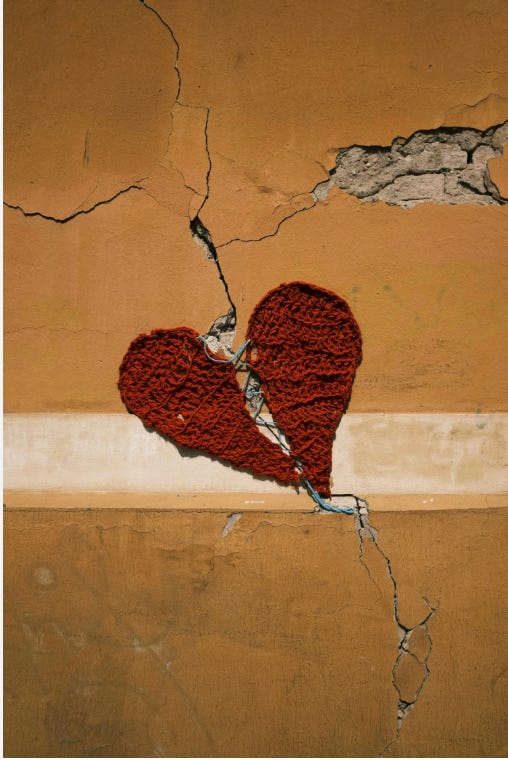
When you take stock of your mental inventory of broken relationships, what gets filled in? Names, I am sure. Perhaps an event that ruptured trust. Maybe even reconciliations that never happened because anger was too intense. That last element was on my mind this week as we marked Tisha B’Av, one of the most tragic days in the arc of Jewish history. All the way into the modern era, the Jewish community has been met with deep loss, but it’s the destruction of Jerusalem that gets the full spotlight on Tisha B’Av. That relationship gets a fascinating treatment by the Rabbis as they personify Jerusalem as being in a relationship with God.
This popped into my head as I reflected on the ritual of Tisha B’Av. Every year, we sit on the floor for Tisha B’Av, and then, almost before the fast ends, the calendar hands us Nachamu, nachamu ami — comfort, comfort My people, which is the traditional haftarah that always follows the 9th of Av. This year, it was a fast turnaround. Grief on Thursday, consolation by Shabbat. But the thing is, if you’ve ever tried to comfort someone too soon after a rupture: a friend, a spouse, yourself, you know how that turnaround can feel too rushed and painful.
There’s a passage in the Midrash Pesikta Rabbati, a 9th century aggadic collection of teachings on the Torah and Prophets that refuses the rush.
God says to Jerusalem: accept comfort from Me — kabli mimeni tanchumin —
and quotes Song of Songs:
“Open for me, my sister.”
Rather than gratitude, Jerusalem offers a condition:
eino mekabel mimcha tanchumin ad she’ani ve’atah medabrim tochachot —I will not accept comfort from you until we have first spoken words of rebuke to each other.
She cites the next verse of the same Song back at Him:
“Come, my beloved, let us go out to the field... let us lodge among the villages to a place with no masa u’matan, no transactional dealing.
Sit with that condition for a second, because it’s not what we expect from a reconciliation story. Jerusalem doesn’t say first apologize, then I’ll listen. She doesn’t say let’s skip to feeling better. She says: before there can be comfort, there has to be a field , someplace outside the marketplace, outside the exchange of goods for goods, where the grievance itself gets spoken.
A second passage in the collection makes the grievance explicit, and it’s full of chutzpah.
Israel says to God: ad eimatai kach — how long like this? Didn’t You write in Your own Torah, “he who kindles a fire must pay for the damage” (Exodus 22:5)? And You are the one who kindled it — “from on high He sent fire into my bones” (Lamentations). You have to rebuild it. And You have to comfort us Yourself, not through an angel, not through an intermediary, but b’chvodecha, in Your own glory.
That’s Israel citing tort law against God. Using God’s own statute to put God on the hot seat. And God’s answer runs counter to much of what we might see in our relationships. It doesn’t blame or go on the defensive.
chayeichem, kach ani oseh — by your life, I will do exactly that. Boneh Yerushalayim Hashem, nidchei Yisrael yechanes — I will rebuild Jerusalem, gather the scattered — va’ani hu she’menachem etchem. And I am the one who comforts you.
What both passages are doing is refusing a shortcut most of us reach for instinctively when a relationship is broken: get to the good part fast. Comfort that arrives before the grievance has been fully said out loud isn’t comfort. What makes God’s acceptance here notable is that God doesn’t try to bypass the litigation. Israel serves the complaint, cites the statute, names the specific harm, and God doesn’t send a proxy to handle it.
This dynamic of holding both the pain and the hope for a future is both an ancient and contemporary construct. We know this feeling well from our own lives, the scorn of a friend or loved one living alongside a glimmer of love. The Mei HaShiloach adds a beautiful element to this midrashic understanding.
Commenting on the pillar of cloud and fire that escorted the Israelites back in the Exodus story day and night, the Izhbitzer reads a verse from Psalms 68:36:
Awesome is Elohim from Your sanctuary, the God of Israel gives strength and awesome might to God’s people, blessed is Elohim." "Awesome is Elohim." There are so many reasons to fear and tremble before God, yet still, at the place of the Holy Temple, where all fear goes forth into the world, of this it says, "Awesome is Elohim from Your sanctuary," the source from where "strength and awesome might" go forth to God’s people Israel. Because of this the verse ends, "blessed is Elohim," meaning that God is a fountainhead of life that is ever flowing and never ceasing.
Awe and fear is real that results in a certain form of dread when it comes to God is real. But specifically from the place the fear comes out of, the Temple, that same place hands Israel strength. And the verse doesn’t pause between the two. The divine blessing follows immediately, because, the Izhbitzer says, a person shouldn’t worry that the fear will interrupt the flow of blessing because it’s a living source. Fear and trust can be drawn from the same well.
These two texts are hinting at something deep, albeit from slightly different vantage points. The Pesikta's structure is sequential, the airing of the grievances have to happen before comfort. You don't get to skip the field, the rebuke, or the citation of the statute. The Izhbitzer''s structure is simultaneous, fear and strength issuing together, from one source, without one waiting on the other to finish.
Put them together and you get something better than either alone. Real repair isn't a straight line from grievance to comfort, where you close out the complaint and then, separately, feel loved again. It's a relationship where the complaint and the love were living side by side. You still have to say the grievance; that part is not optional, and no one else can say it for you, and no one else can hear it in your place. But once it's said, it turns out it was being held the whole time by the same hand that's now doing the comforting.
That, I think, is the real content of how Nachamu, the emphatic message of comfort that follows every Tisha B’Av is meant to be heard. It’s not an equation or check box that says, “ok, the pain is over so now comes the comfort. But rather, the words of comfort were only ever going to be trustworthy if they came from the one willing to stand in the fire in the first place.
So it was for Jerusalem and God then. So it is for all of us now in whatever relationships we thought of at the top of this piece. Rupture is a feature of life because we’re all deeply fallible but in our fallibility, there’s also resolve. It’s a resolve that is built on our ability to hold two things together. We break, we enter…and somehow we repair.
Shabbat Shalom and especially may it be one of comfort.